Numbersense in sports commentary
Does the bad outcome prove the strategy bad?
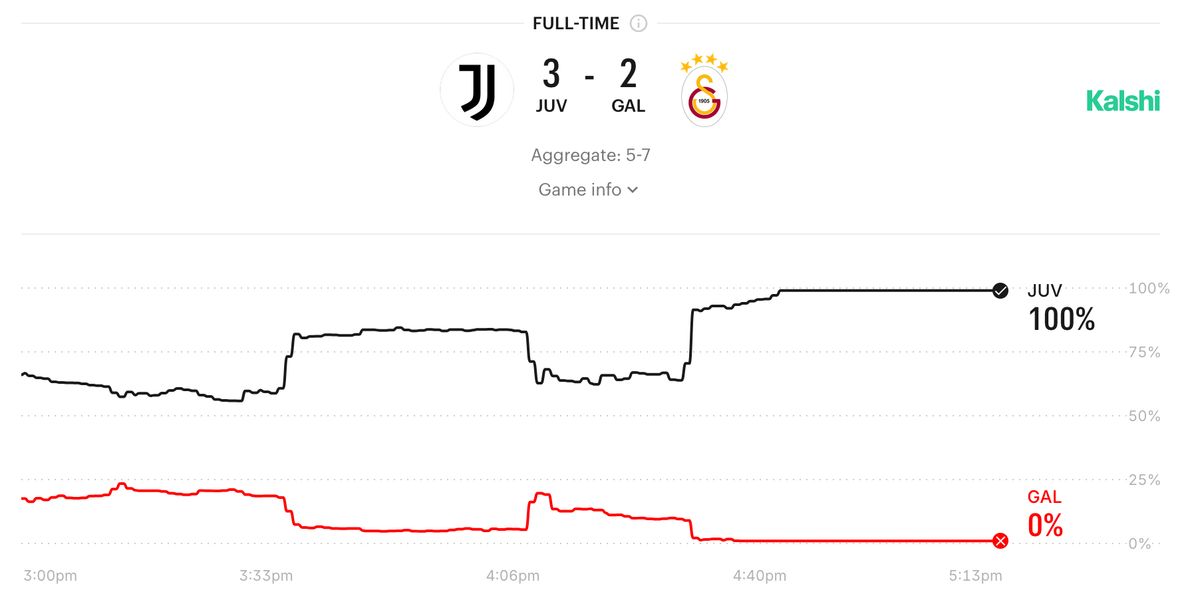
Even though data and analytics are part and parcel of modern sports, it's still jarring to hear sports broadcasters invoke common statistical fallacies.
During an overtime period in the recent Champions League match between Italy's Juventus and Turkey's Galatasaray, one commentator attacked the Turkish team's strategy (at ~97 minutes mark, when neither side had yet scored in overtime):
They [Galatasaray] showed you absolutely the way to not go about protecting a three-goal cushion tonight. From the very start, they never really played enough football. They were more content with trying to stop the game, break the game up, slow the game down.
The background: the two teams were taking part in a two-match playoff for a spot in the Round of 16; in the first match, played the week before, Galatasaray seized a 3-goal lead, which in football terms, is considered a massive advantage; and yet, on home soil, Juventus netted three goals in regular time, leveling the aggregate score (all of that despite playing ten vs eleven since the 49th minute).
According to this broadcaster, the outcome proved the Turkish side's strategy wrong. Instead of a conservative strategy of "slowing the game down," the Turkish side should have – I don't know what his unspoken alternative strategy would have been – treated it as if they did not have a 3-0 lead? Take risks trying to pad the goal difference while leaving gaps in the defense?
The commentary reflects the classic "outcome bias" fallacy of evaluating a strategy based on the realized outcome, not on what information was available at the time of the decision.
Imagine a lottery with just two players, paying out $100,000 for bets of $100. Using the aforementioned flawed logic, the loser should not have played in the first place; simultaneously, the winner obviously made the right decision to participate. However, at the time either makes the decision, they possess the same information so either both join or neither. You can't have it both ways.
Galatasaray ultimately scored two goals in overtime to join the Round of 16. The broadcaster didn't take back what he said earlier. The ultimate outcome should have confirmed the wisdom of the original conservative strategy, no?
Notably, at the start of the broadcast, the hosts cited some damning statistics: in the history of the Champions League, at this stage of the competition, we were told that out of 49 teams that were down by three or more goals after the first match, only four managed to overcome the deficit and advance to the next round. That's a probability of 8%. (With Juventus's loss, it's four out of 50.)
It would be amusing to analyze those 50 matches, and check how many of the teams that were leading after the first match deployed conservative tactics, and how they fared, relative to those that didn't.
P.S. [3/2/26] Corrected a typo. Clarified that Galatasaray didn't win the second match but won in aggregate.