Maps of Top X
Exploring a popular way of making maps
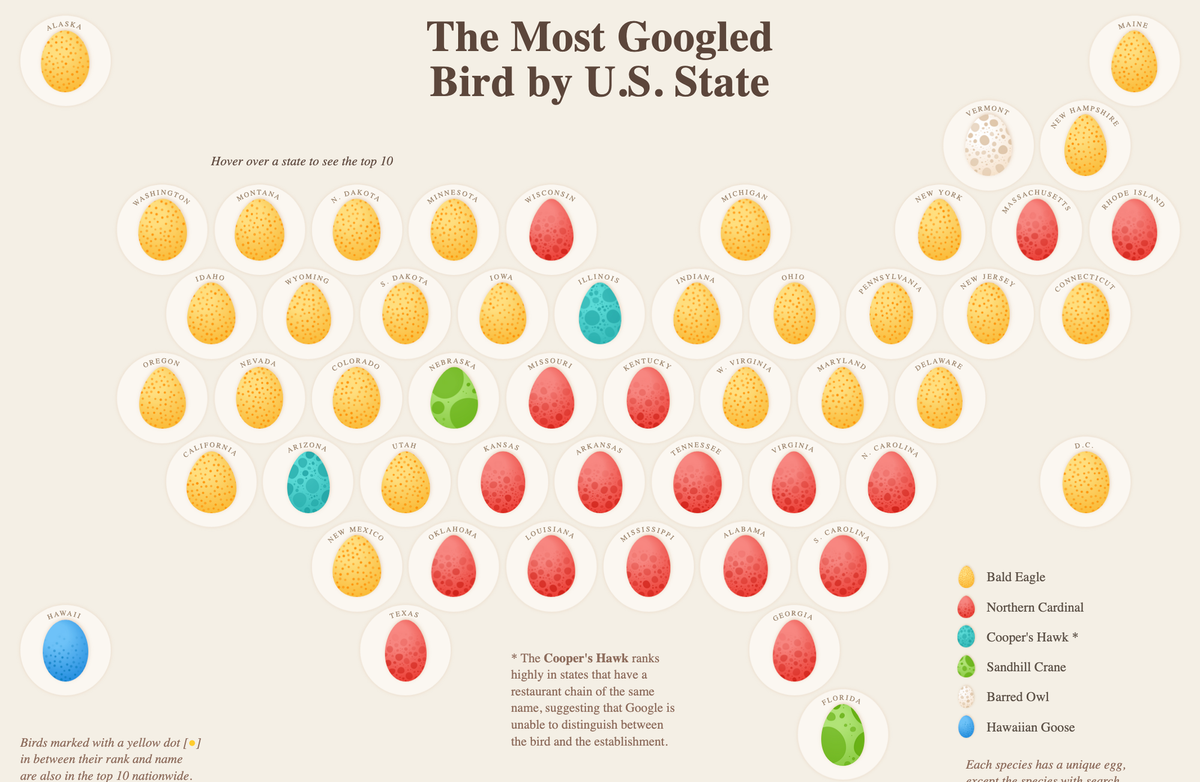
Some years ago, maps of Top X came into fashion. The example above is lifted from Visual Cinnamon's Webby Award nominee (and co-winner). This is just one chart from their massive project. See here for my short reviews of all nominees.
The most common version of maps of Top X is the map of Top 1. Using the tile map as the base, Visual Cinnamon displays every state as a circle of equal size. The tile map condones distortion of areas as well as of relative positions. The project concerns bird-watching. Each state is represented by its #1 Googled bird. At a glance, we can see that Bald Eagle (yellow) and Northern Cardinal (red) dominate Google searches. There are only seven states in which neither of these two birds came first.
Maps of Top 1 dump most of the data. It doesn't differentiate between states in which residents split their attention across a large variety of birds, and states in which residents are obsessed with a small number of birds.
To show what's possible, I made some maps of Top 2.
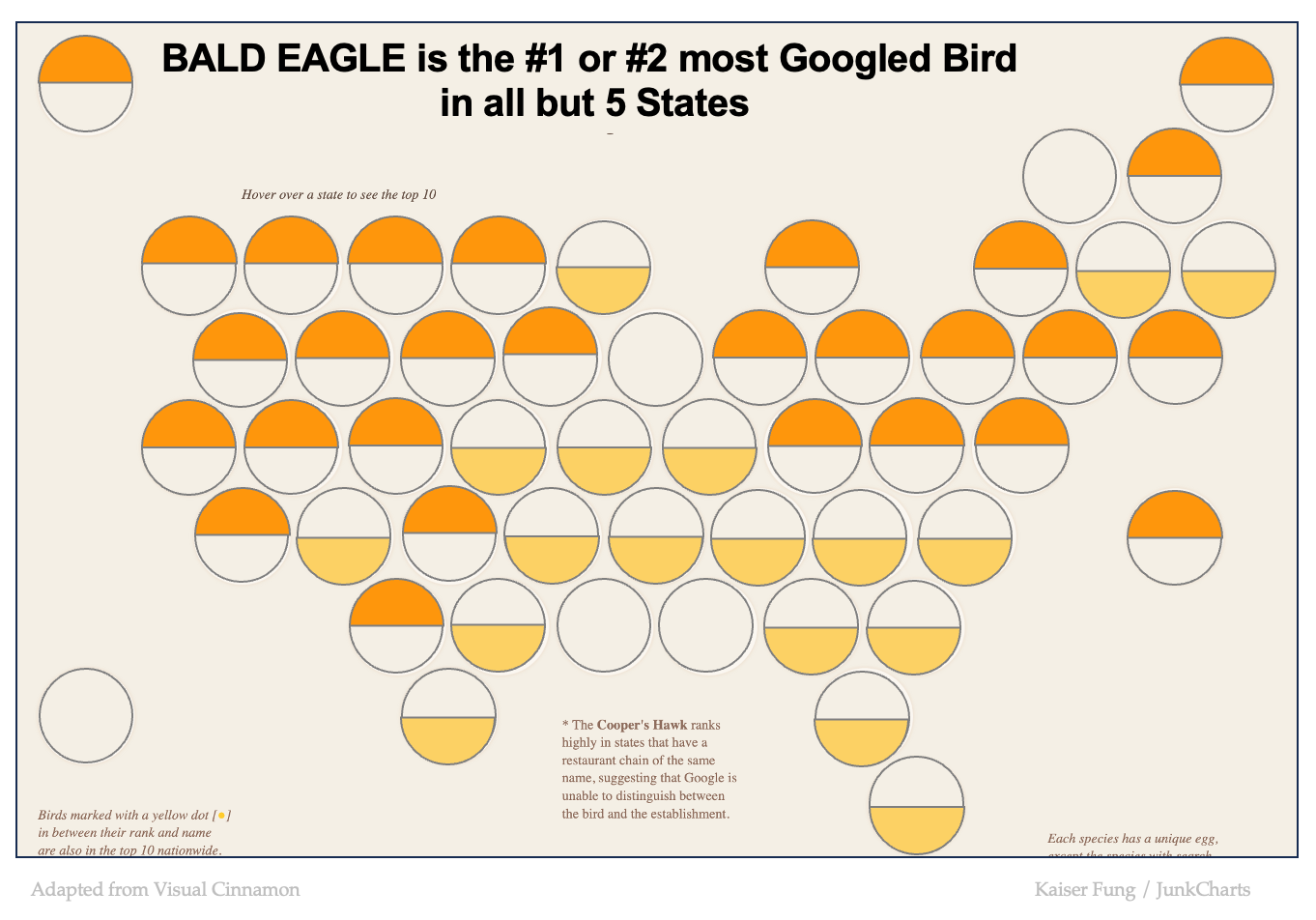
This map of Top 2 shows where Bald Eagle was the most popular, measured by Google searching. This bird is popular almost everywhere; only in five states does Bald Eagle not end up Top 2 on Google. In roughly half of the highlighted states, Bald Eagle was the #1 searched bird.
You can imagine what the map of Top 1 looks like by ignoring the yellow, lower semicircles. The story is enriched by just adding back one layer of information.
Deploying the small multiples principle, I made a map of Top 2 for Northern Cardinal.
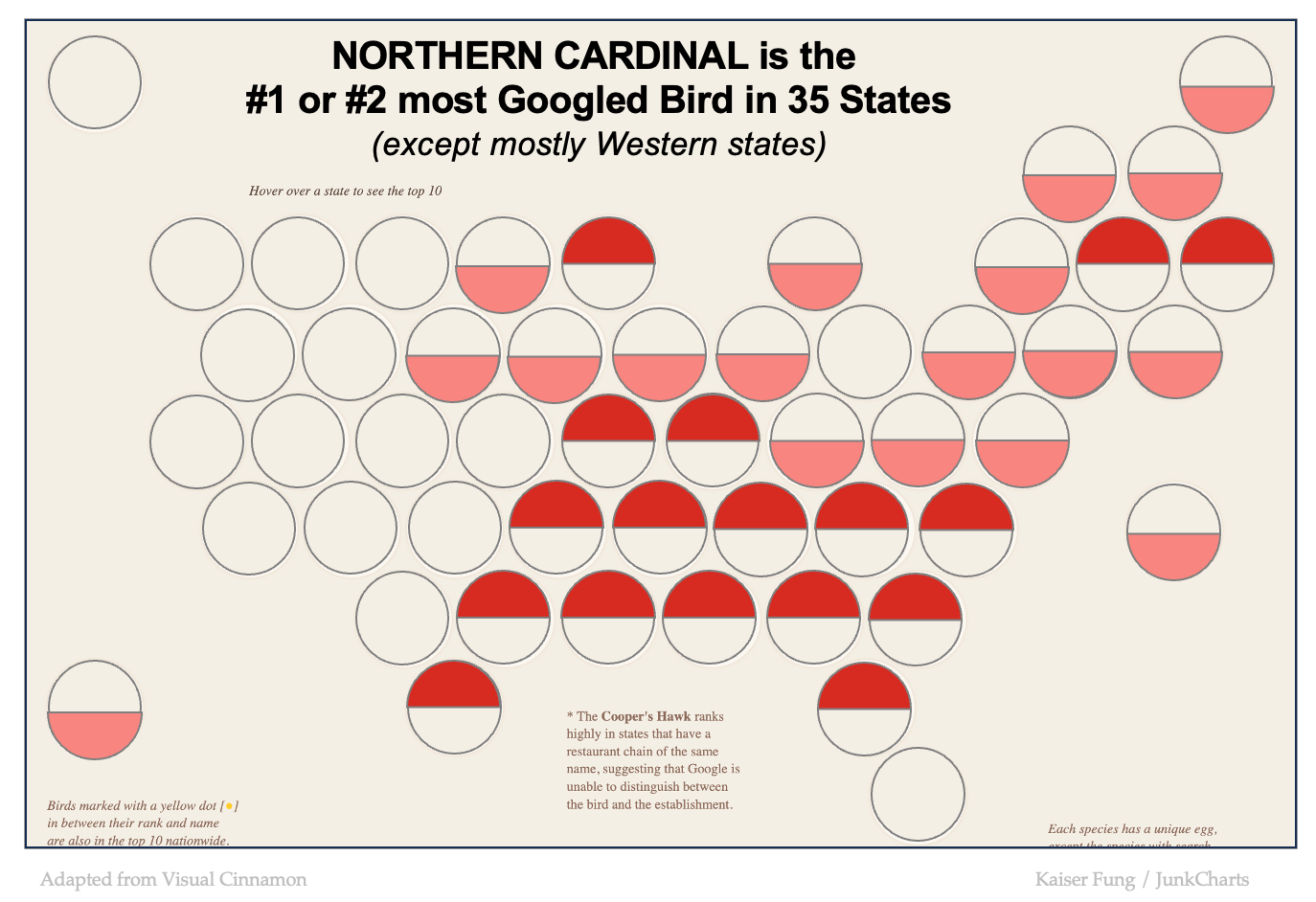
Outside of Western states, Northern Cardinal is intensely searched. In the South, this bird is ranked #1, surpassing Bald Eagle, which frequently drops to #2.
A map of Top 1 would be if we only pay attention to the deep red, upper semicircles. The story is richer just because I added one extra layer of information.
The third map addresses those states in which Bald Eagle and Northern Cardinal do not account for both top positions.
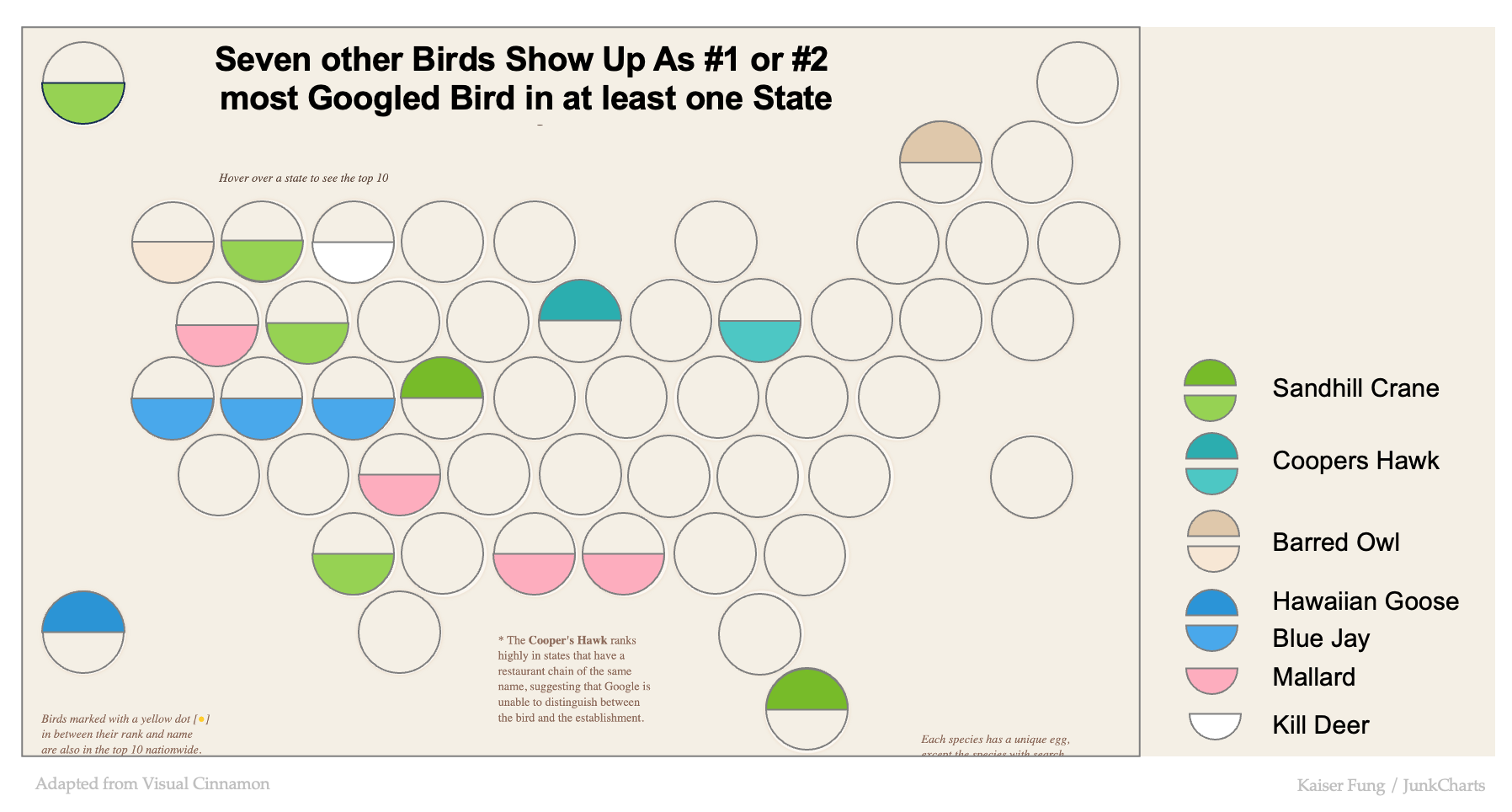
There are seven other birds that feature. Most of these less popular birds show up as #2, not #1. Thus, they don't appear on maps of Top 1.