Open questions of the pandemic, part 1
Kaiser discusses some open questions of the Covid-19 pandemic
As we open another year of living with Covid-19 in the U.S., it's high time we asked the difficult questions.
1. What does living with the virus mean?
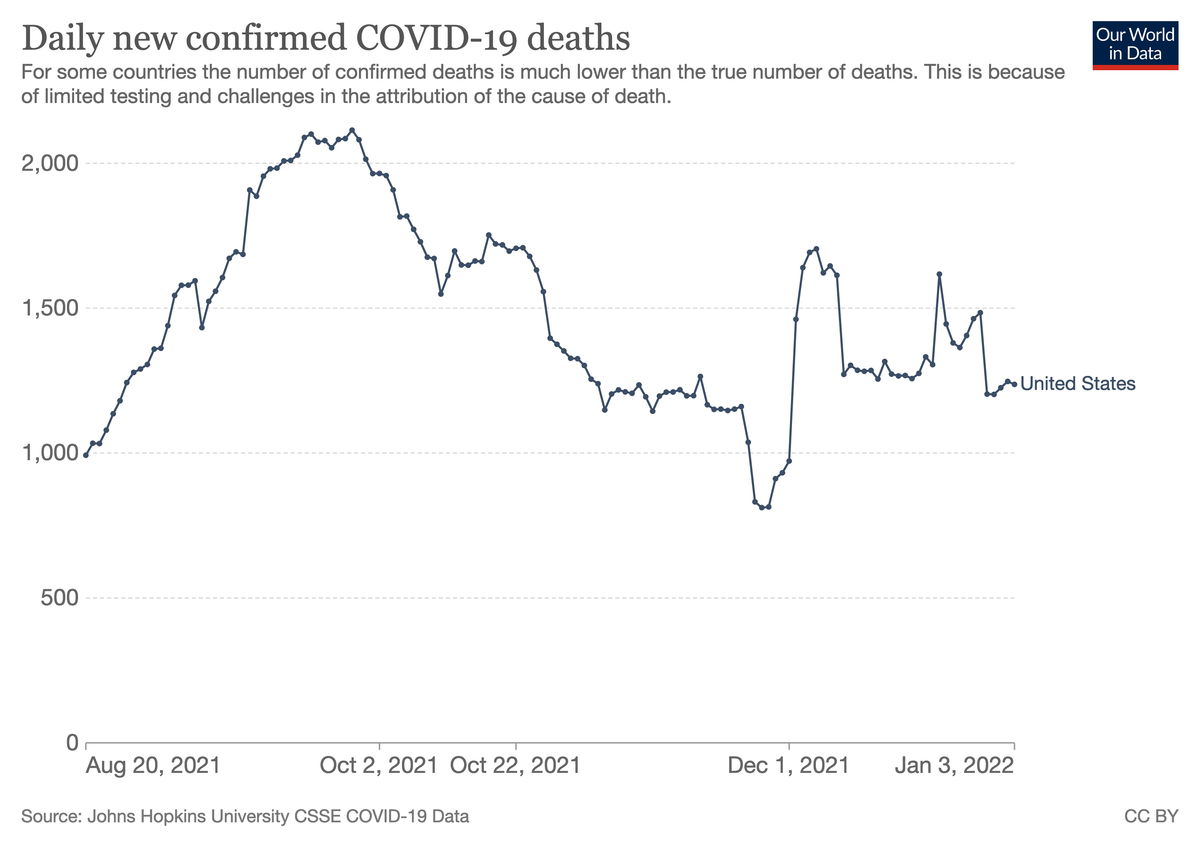
The following chart shows the number of Covid-19 deaths in the U.S. for three months from August 20, 2021 to January 3, 2022:
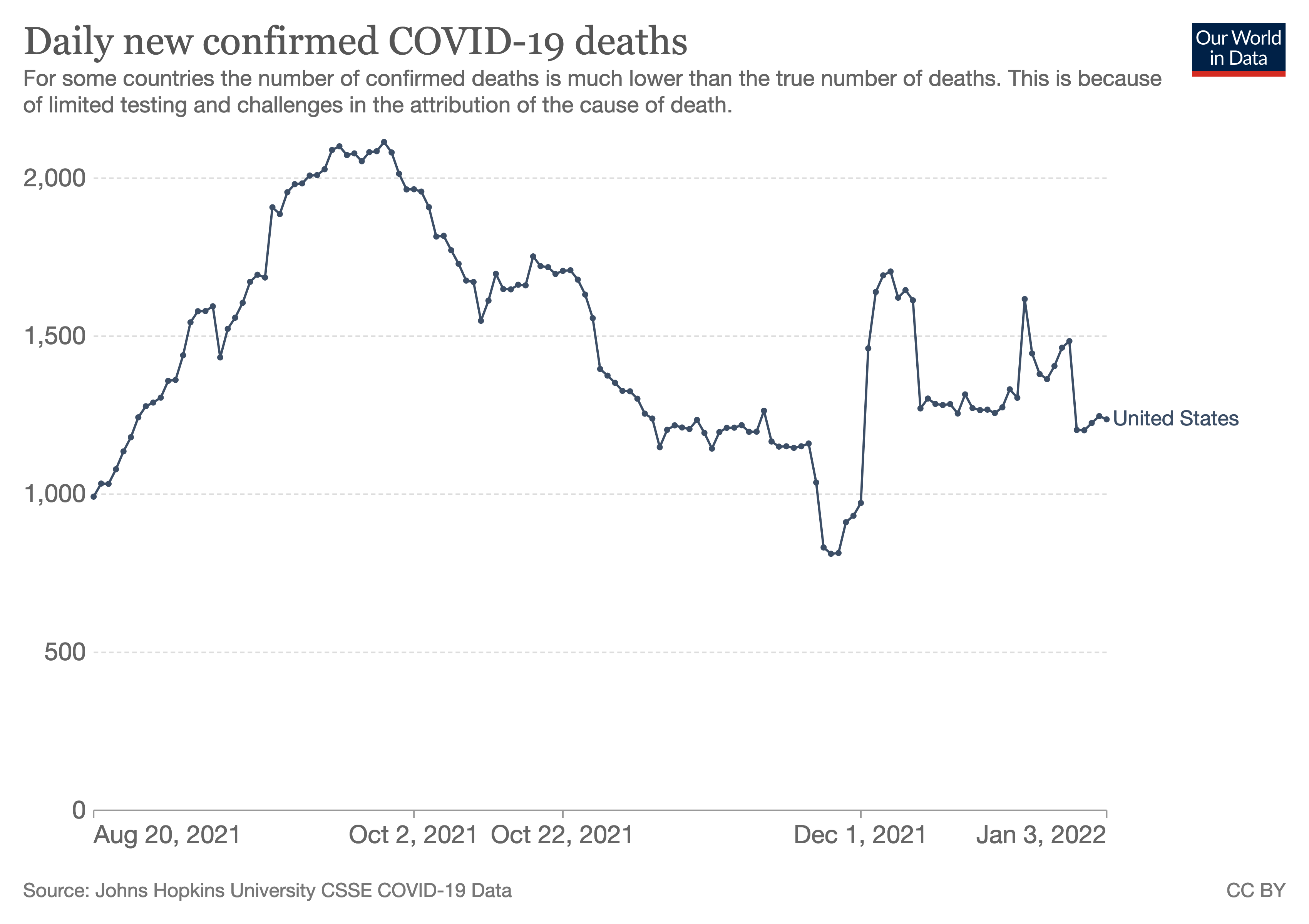
The data come from the OurWorldinData website. For all I know, these numbers are most likely undercounts. But what do we see in the chart?
For over three consecutive months (136 days), no fewer than 1,000 Americans died each day from Covid-19 (ignoring the reporting delay in late November probably associated with Thanksgiving). It appears that the U.S. government is managing to a roughly 1,200 daily deaths run rate, as the line goal-seeks this number on the right of the chart. Twelve hundred daily deaths amount to 438,000 annual deaths.
In a bad year, the flu kills ~40,000. So this "flu" is still causing 10 times as many deaths... with almost 60% of the population fully vaccinated with two doses, some with three doses.
Is Covid-19 like the flu? That was the question from day 1 of the pandemic. Has Covid-19 become like the flu? That is the shocking claim of some experts.
2. Endemic versus pandemic
Two common headlines have circulated in the media recently. One claims that Covid-19 is becoming endemic, like the flu. Another argues that this Omicron surge is fantastic because it is "mild" and getting lots of Americans infected is a great thing as it induces immunity through natural infections. (The recent policy shift that shortens the isolation time for infected people seems to endorse such a viewpoint.)
Those two headlines cannot coexist. Endemic diseases like the flu do not have lasting immunity - the defining characteristic of an endemic disease is that one will get re-infected periodically. Separately, the pursuit of "herd immunity" and the associated use of SIR-type epidemiological models assume that once infected, someone cannot get reinfected, as infected people are removed from the susceptible population. (For endemic diseases, one uses SIS models in which previously infected people become susceptible again.)
If Covid-19 is really endemic, there is no point in hosting Covid-19 parties because getting infected once does not prevent future reinfections.
3. Zero Covid
In the West, our journalists love to point out that lockdowns don't work. When they do work, our journalists say people are upset, or they say zero-covid countries are a risk to the rest of the world (link), or that people are leaving in droves (the journalist obviously belongs to a certain class for which people can pay to obtain citizenship status anywhere they like), or that people are starving to death.
Maybe the only criterion these journalists use is economic (and even that may not be supported by data) because the following chart shows the cumulative death per million in selected countries from the start of the pandemic to now:
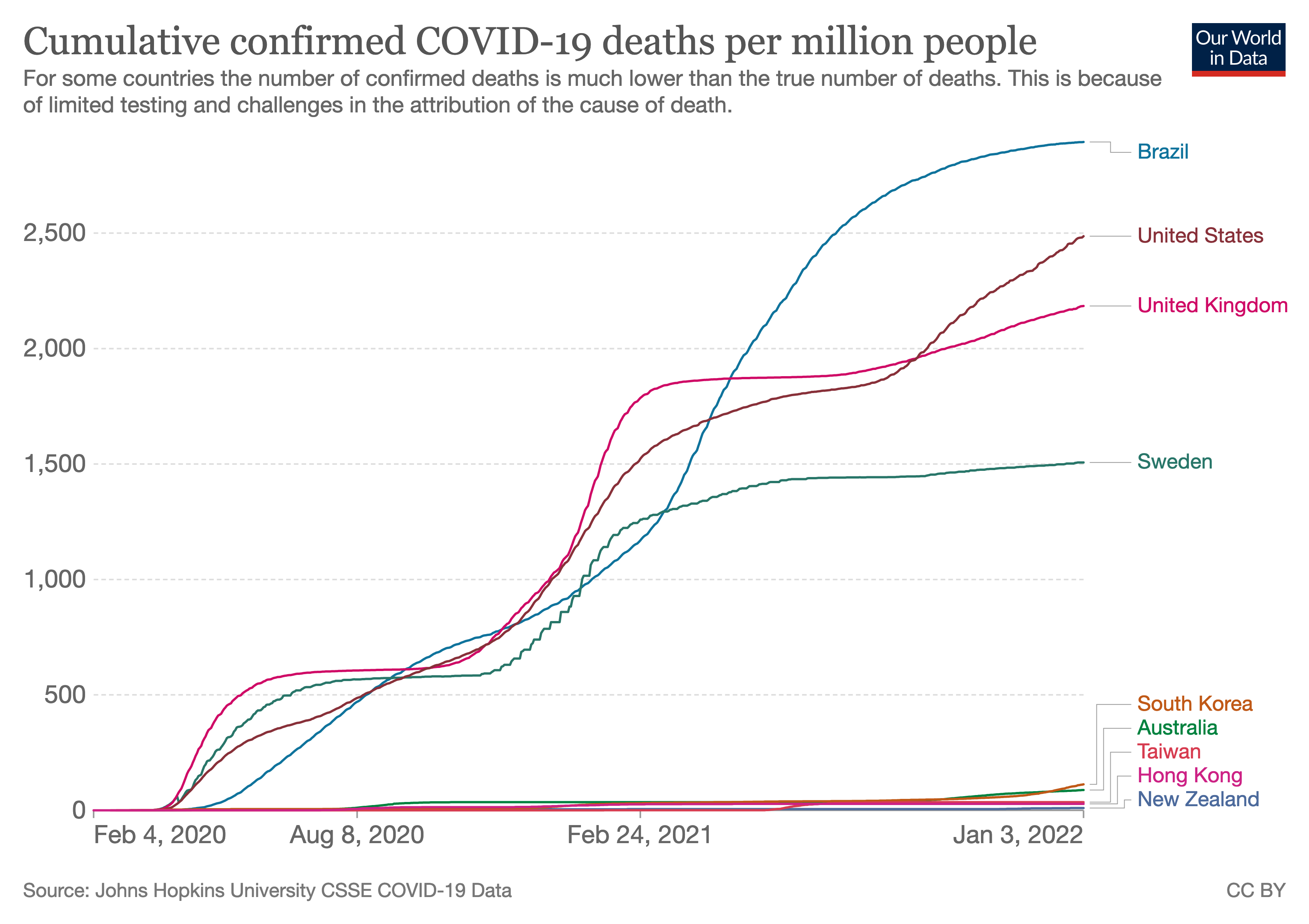
There are two clusters of countries. The top 4 (Brazil, US, UK, Sweden) are countries most often associated with anti-lockdown sentiments. The journalists in these countries argue that lockdowns have no benefits while destroying the economies, and worse, usurping the freedom of their citizens. Sweden, one should note, was initially no lockdown but subsequently changed strategy.
The other cluster (South Korea, Australia, Taiwan, Hong Kong, New Zealand) contains countries most associated with zero Covid policies, which typically means lockdowns whenever cases flare up. The "failure" of such policies has led to cumulative death rates that are at least 20 times lower than those experienced by the anti-lockdown countries.
***
The news on Covid-19 is confusing and frustrating. It won't get better until we clarify some of these fundamental questions - there can be two sides to each debate but what muddles things up is when people make arguments that require holding incompatible views simultaneously.
The next post will feature a few more open questions.