Drowning in colors
These colors are both empowering and limiting
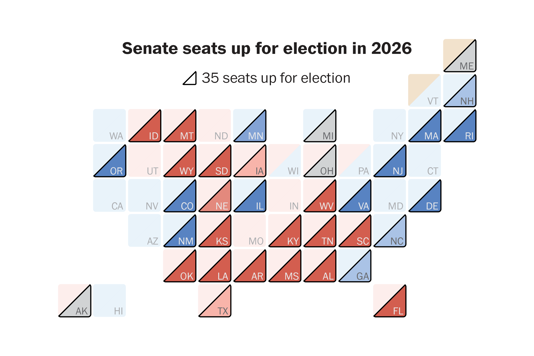
This tile map I saw on a news site left me perplexed. The headline tells me it's about the upcoming midterm elections in the U.S. Senate: how the Democrats feel more confident about their chance of gaining control of it.
Up top, it mentions 35 seats are up for grabs. That is the extent of the legend. (My brain kept mistaking the two squares on the bottom left as part of the legend, but this version of the tile map pairs up Alaska and Hawaii, depositing them there.) I happened to be meeting with a politically active friend at the time, and she was able to figure the chart out without much trouble. So the problem lies with me, or anyone who's not already steeped in the world of elections.
The designer relies on the reader to bring a lot of knowledge. That each state has exactly two senators, which is why each square is divided into two triangles. If the triangle has an outline, that seat is being contested. In the diagram above, states fall into two groups: those with no elections this fall, and those with one election. For some reason (opaque to me), the seat up for election is always presented as a lower triangle.
For the 35 states with one election, the color in the outlined triangle shows the current poll result: red for Republican, blue for Democrat, multiplied by two shades each, indicating strong or weak advantage.
Wait, they also use a gray color, which would mean a toss-up.
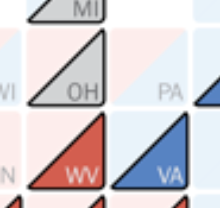
Wait wait. Red and blue appear in another pair of shades, even lighter than the ones just mentioned. These are used found in seats that are not up for election. They show which party currently hold those seats.
Wait wait wait. I'm missing yet another color. In Maine and Vermont (north east corner of the map), the upper triangle takes on a skin tone, that is neither red nor blue nor gray. Ahh, those seats are held by an "independent" or "third party". (Both "caucus" with Democrats.)
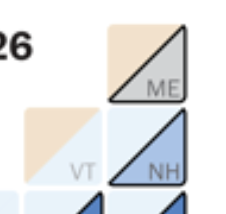
The designer must feel lucky that there aren't any strong third-party candidate in any of the 35 races; otherwise, yet another color would have to be added to the list.
I was drowning in the number of colors; a legend will have offered a small reprieve.
The designer's choice of color palette is both empowering and limiting.
These colors are very rich indeed. Take this selection of states.
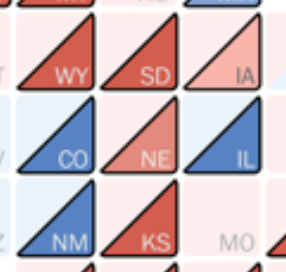
In Montana, neither seat is up for election, and both are currently held by Republicans. In Kansas, Wyoming and South Dakota, one seat is up for election, and a Republican candidate has a strong lead in the polls, while the other seat is also held by a Republican. The situations in Nebraska and Iowa are similar, only that the lead by the Republican candidate in the single race is deemed weaker.
On the other end, Colorado, Illinois and New Mexico are Democratic leaning states. They each have one election, in which the Democratic candidate enjoys a healthy margin while the other seat is currently also Democratic.
All of this information is conveyed efficiently without showing a single number. (It makes a big difference now that we have figured out how to read the chart!)
While writing the above, I discovered yet another nuance... wait wait wait wait!
You might also have noticed that the shade of red for Iowa is a bit different from the shade of red for Nebraska. So one supposes that the party advantage is not encoded in a five-point scale (Strong R, weak R, toss-up, weak D, strong D). It appears that they are using a finer gradation. (Without the benefit of a legend, I can only guess.)
We should also recognize that the chart design has some omissions – in spite of its richness.
For example, which party occupies the seat that is up for grabs is absent from the chart. We think the color of the upper triangle represents the affiliation of the senator not involved in the upcoming elections. How about the other one? It's absent because the color of the lower triangle is employed to depict poll results. Because of this omission, the reader can't tell which of these seats is predicted to be a party "flip". Flips are the keys to Democratic control of the Senate.