The greatest nations on earth
How you compare to others
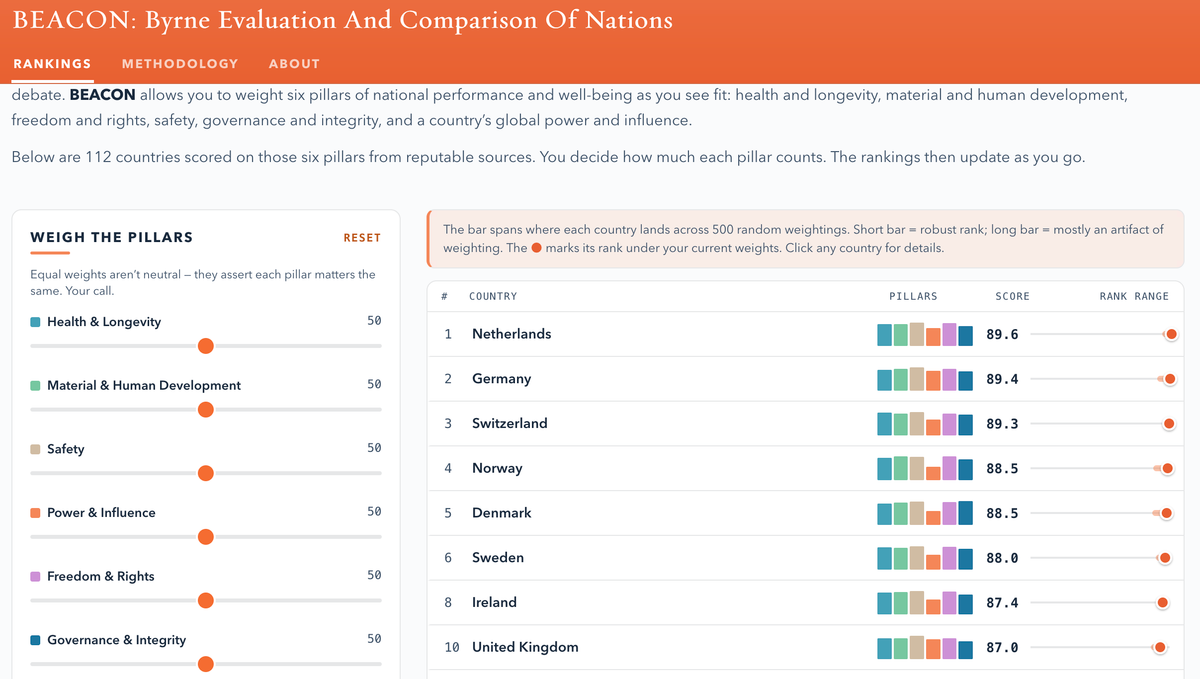
Reader Kirsten P. sent me to Ben Byrne's website (link), where we learn that Europe has the greatest countries on earth.
Byrne presents a solution to a visualization challenge that arises frequently in business and social science studies. We have a composite ranking, built from component ratings. The entities being ranked can be placed into larger groups.
In this case, the composite ranking is the greatness of nations. The component ratings (what Byrne calls "pillars") consist of six factors, each of which is drawn from published statistics by reputable organizations. The entities are countries, and the grouping is by continent.
The right panel is the key event. The countries are sorted by the composite ranking from best to worst. The component ratings are visualized as a set of columns. These columns are not labeled, indicating the designer's assumption that it's of secondary interest.
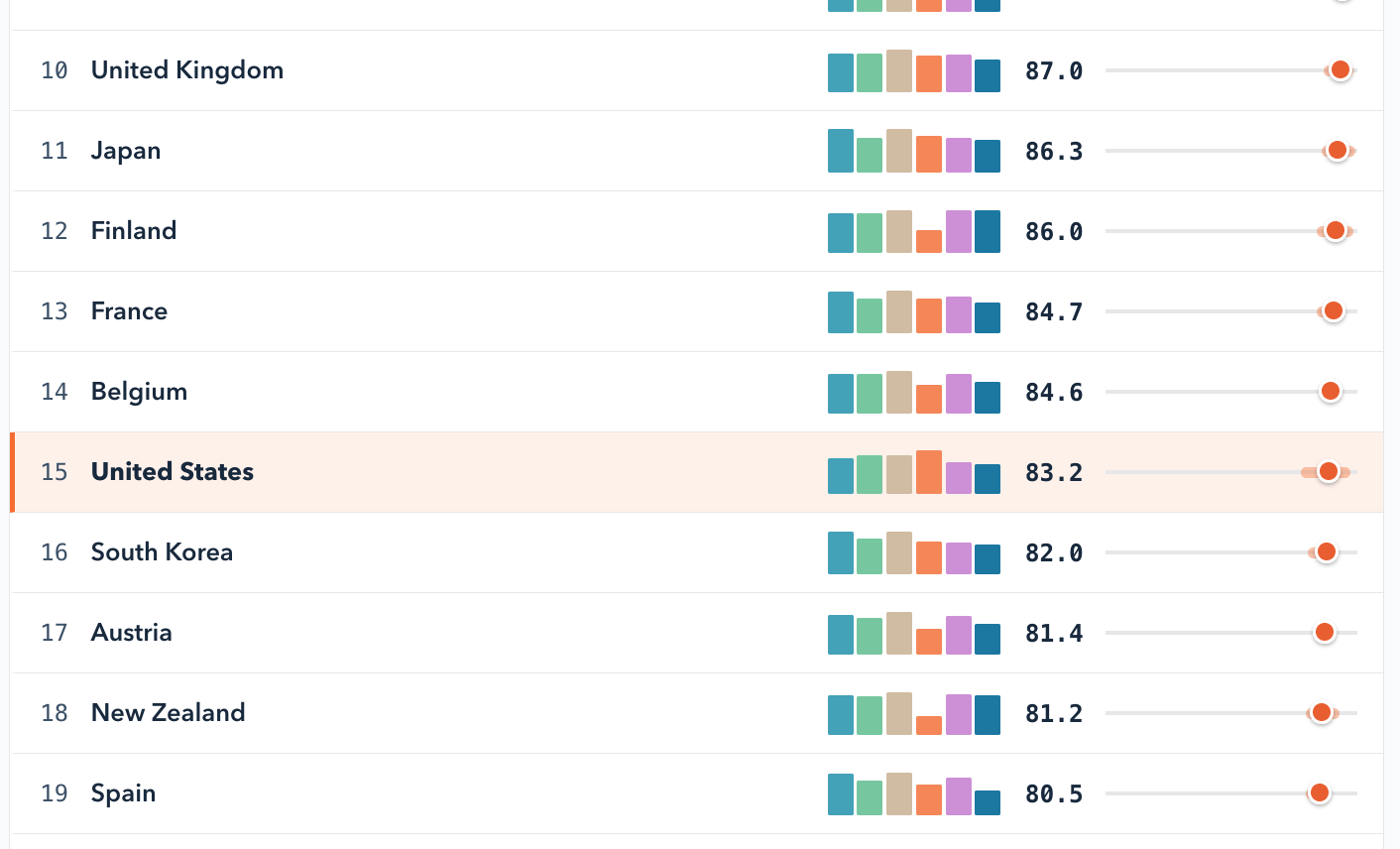
The "rank range" on the right side is quite interesting, and I'll come back to it.
The right panel by itself would be a sufficient chart.
The capacity of the chart is expanded by way of the left panel, which offers users a set of controls. This interactive element attempts to solve one of the conundrums of any ranking procedure: users may not share the same preferences as the creator.
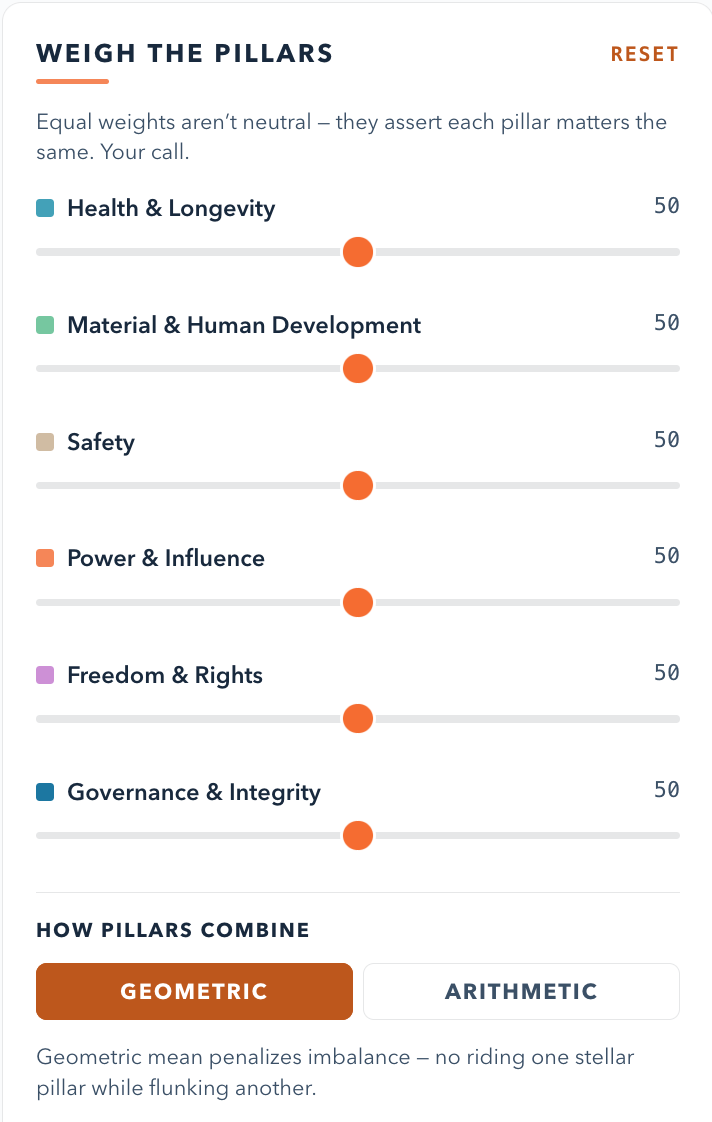
The left panel reveals that the "default" (read: canonical) composite ranking issued by the creator is one that combines the component ratings using a geometric mean, with equal weights on each component.
To which Byrne quipped:
Equal weights aren’t neutral — they assert each pillar matters the same. Your call.
This point can't be stressed enough. Having no opinion is an opinion.
Readers can move the dots around to indicate the importance they attach to each component. The scale used here is redundant – if one moves all dots to the right, as if to say every component is extremely important, then the result is identical to the default setting. On every horizontal position, if all dots are aligned vertically, we have the same composite ranking as the default. I don't see this redundancy as a defect; in a way, it informs any reader who rates everything as important that they effectively hold nothing to be important.
Now, let's return to the "rank range" section of the right panel.
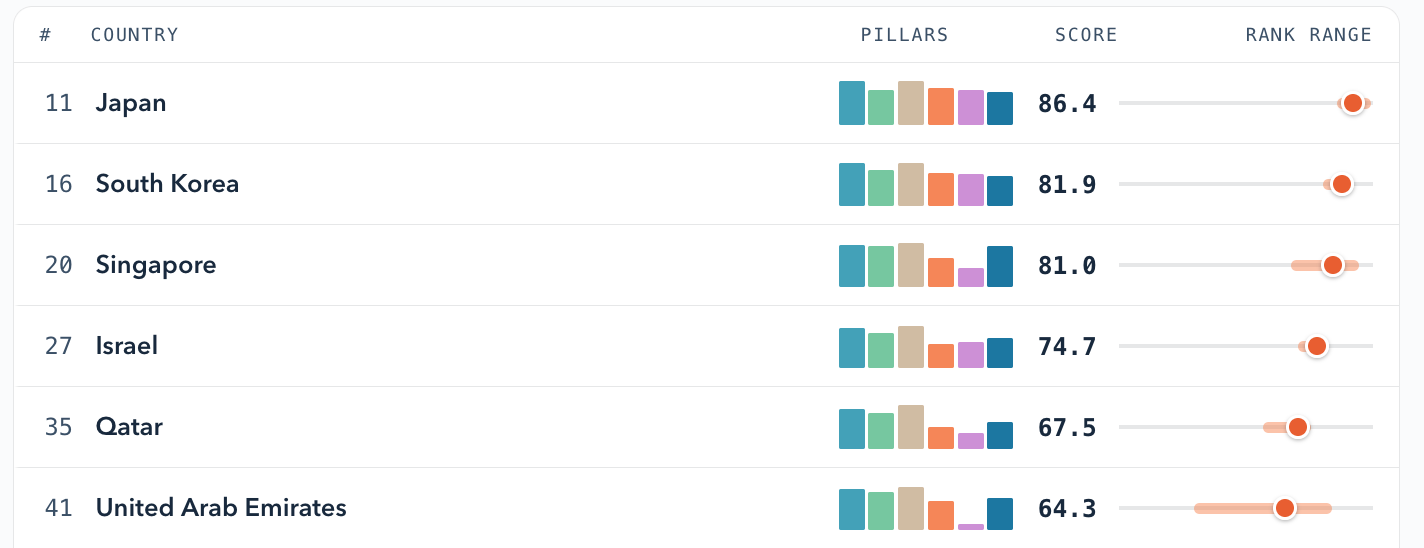
This is an attempt to capture the "uncertainty" of the composite ranking. Specifically, Byrne is concerned with uncertainty arising from the component weights. This is precisely the issue that I mentioned above: people have differing views on the relative importance of those six components.
What Byrne did here is to simulate 500 people, each of whom have their own preferences. He samples randomly amongst sets of six numbers that add up to 100%. For each set of preferences, a composite ranking results. These rankings form a distribution, and the "rank range" shows the middle 90% of the distribution. (This method of generating preferences assumes that all possible allocations of weights have equal chance of occurring.)
Simply stated, a wider range indicates that the ranking is sensitive to the individual's choice of weights while a narrow range says it doesn't really matter what weights are applied.
In effect, the rank range reflects the underlying variability of the ratings across components. If a nation achieves similar scores across all six components, then the composite score wouldn't vary much no matter how we arrange the weights. On the other hand, if the nation scores much lower on one or more components, then it could achieve higher ranking if those components were downvoted, but much lower ranking if they were upvoted.

This explains the wide range shown for UAE, which has an extremely low rating for "Freedom & Rights". The composite rankings on the left side of the range are those that place heavy weights on Freedom & Rights; the ones on the right side of the range ignore this component.
The dot, which represents this particular reader's preferences, is right skewed. (I set Health and Governance components higher, and everything else, including Freedom, in the middle.)
Because the chart adjusts in real time, you can observe the effect of changing the weight on Freedom & Rights on the UAE composite ranking. Shifting the weight down moves the orange dot to the right since the low rating on Freedom & Rights becomes less and less important.
I'd suggest fixing the scale of the rank range to [0, 1]. Right now, the minimum and maximum are set to the values found within the subset of nations being plotted. As a result, I have to scroll from top to bottom to figure out the range of the range.
For this type of complex datasets, it's easy to over-complicate it, making the visualization confusing. Byrne has done a great job designing a clean interface, and still offering quite a bit of insights.