VAR technology is ruining football
Two examples of calls that don't improve the experience
I have been watching quite a bit of football (mostly Italy's Serie A) recently, and it's become obvious that VAR technology is ruining the beautiful game.
Goal celebrations have always been fun to watch, especially after spectacular golazos. But nowadays, many an extravagant exultation is now fake. Because the goal is subject to a VAR review, which is a microscopic, backroom operation far away from the action on the field. The referee's (human) decision is not final. VAR's decision, made by VAR referees who are aided by technology, is final.
That's not the official word. But in reality, that's what's happening. The VAR either agrees with the referee's decision, or it doesn't. When the VAR dissents, depending on the situation, either it directly overturns the referee's ruling on the field, or it sends the referee to a viewing booth. The referee's walk to the viewing booth is always rejoiced by the team that is on the short end of the original decision; in almost every case, the referee accepts the VAR's view. Therefore, effectively, VAR is the real referee; the on-the-field referee is the intern standing in for the boss.
This process ruins goal celebrations. The player will celebrate but he knows it's just an act because until and unless VAR accepts the decision, the goal is not official. The review process may take many minutes, particularly if the alleged infraction is a matter of centimetres. We watch the players theatrically arguing for their respective cases. If the goal is ultimately allowed, it feels weird. Should the player restart the dance of joy? If VAR takes away the goal, the already-seen celebration has turned into a caricature. Fans switch from excitement to disbelief, then to anger.
Spontaneity is the casualty.
Despite the orthodoxy, in some cases, it's not clear the VAR decision, even when aided by video, is the better one.
A couple of recent examples.
During an Atalanta-Roma match on Jan 3 2026, Atalanta's forward Scamacca scored a scorching header from right in front of goal, heading in a cross from the left side. Eventually, the goal was annulled by VAR officials for an "off-side" violation. This review took forever.
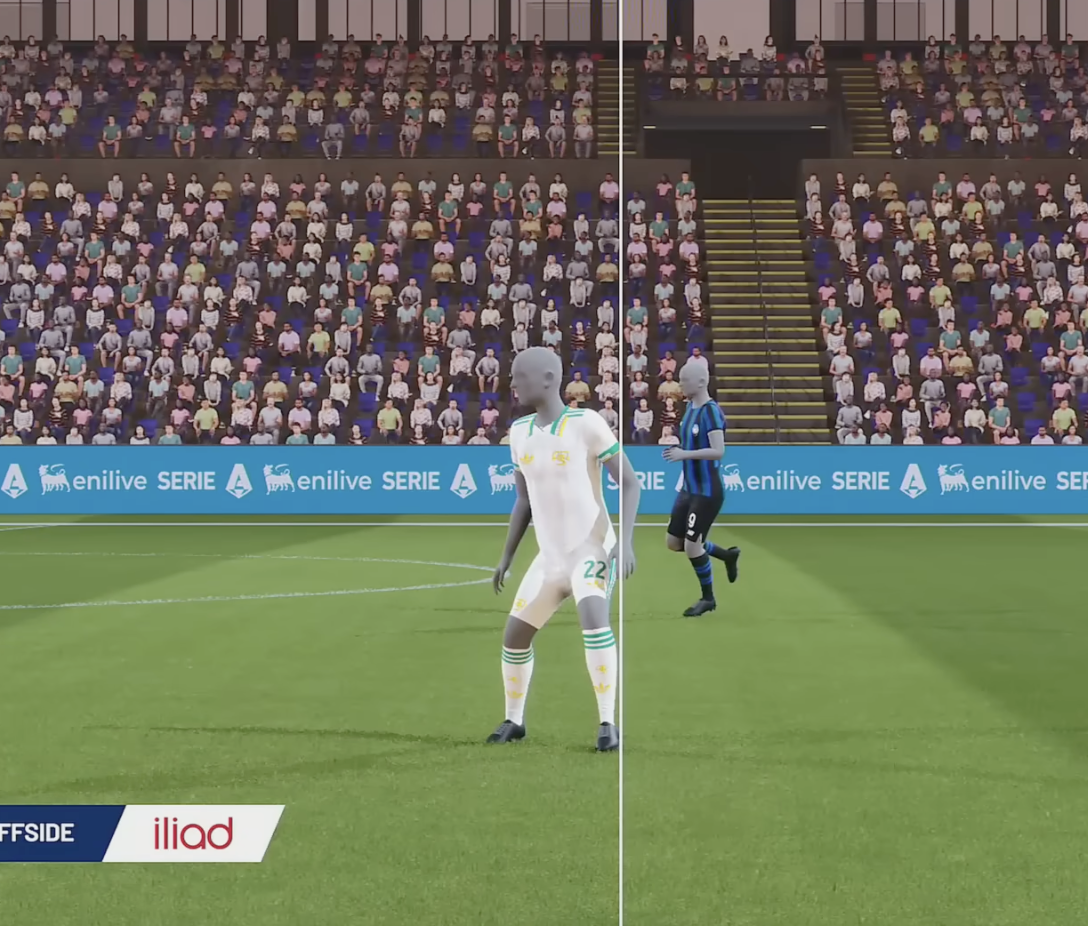
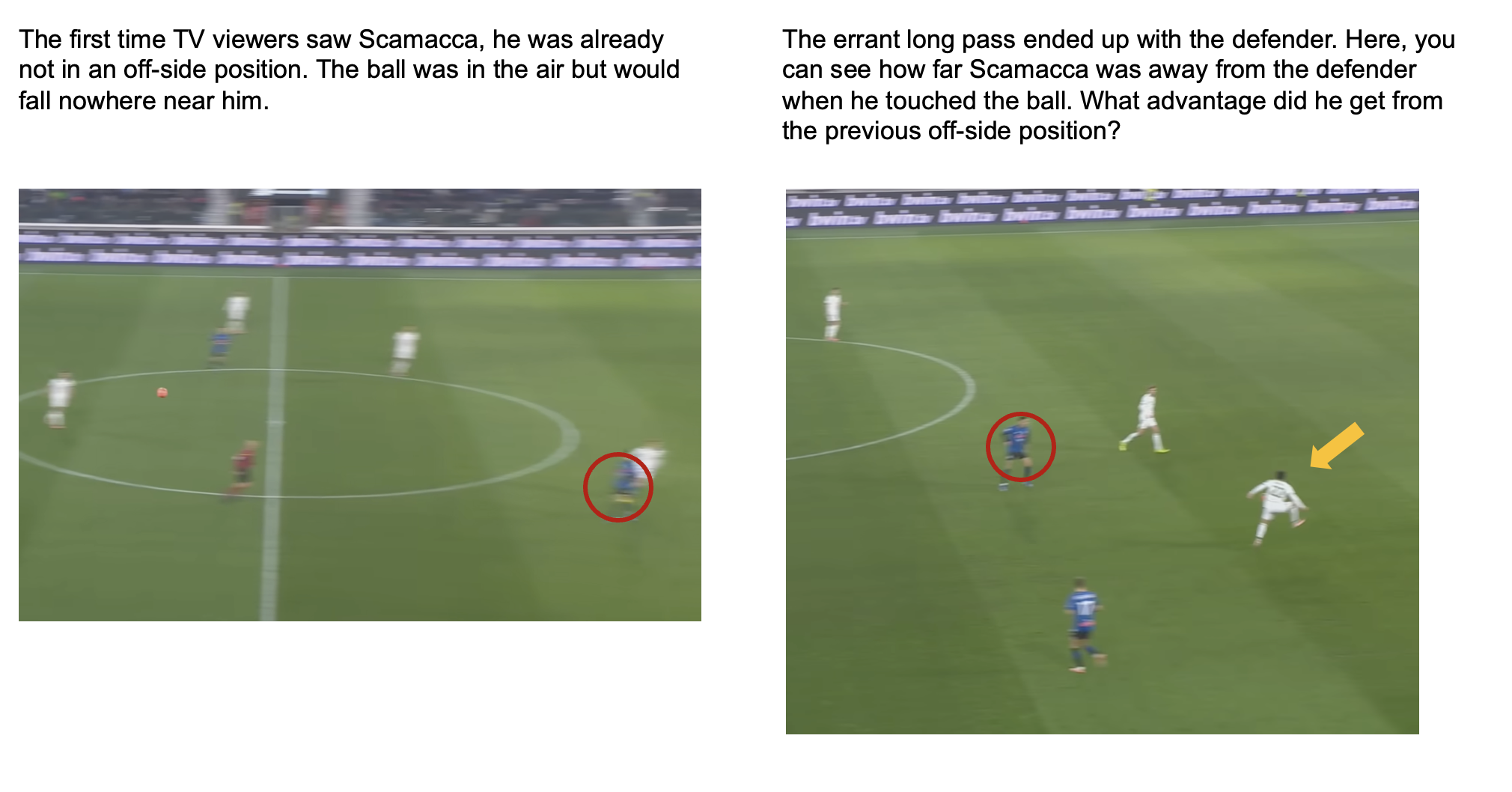
The off-side violation took place multiple passes before the final shot. That moment had no bearing on the ultimate goal, other than Scamacca was momentarily in an off-side position while he was near the midfield circle, that is to say, where he was judged off-side was nowhere near the spot from which he scored, and when he was judged off-side was long before his teammate sent the cross to meet his head.
It was worse than that... because it was an opposing player who gifted Scamacca the ball near mid-field. If one takes the official view, the entire sequence started when an Atalanta player (in blue) attempted to pass the ball to Scamacca in mid-field.
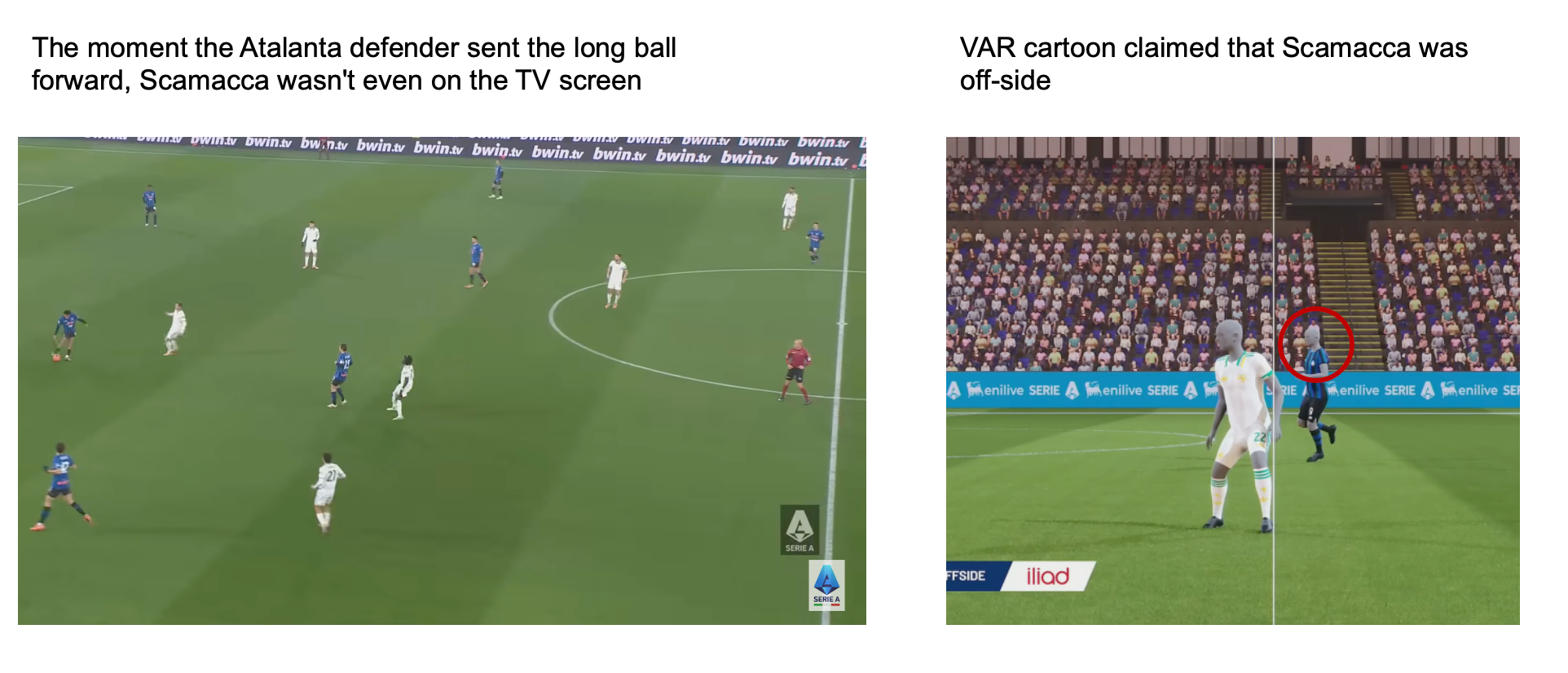
If Scamacca had received that pass, dribbled the ball towards goal, and scored, then the goal should be disallowed because of the off-side rule. No complaint.
But the Atalanta defender kicked a very poor ball that was way out of Scamacca's reach. ("Unreachable" would have been the call if this is NFL.) In fact, the ball went straight to a Roma player (in white), who failed to control the ball, gifting it to Scamacca in a backward "pass". So in fact, Scamacca did not receive the ball in an off-side position from his own teammate; he took a gift from the opponent, in which case off-side wasn't even pertinent.
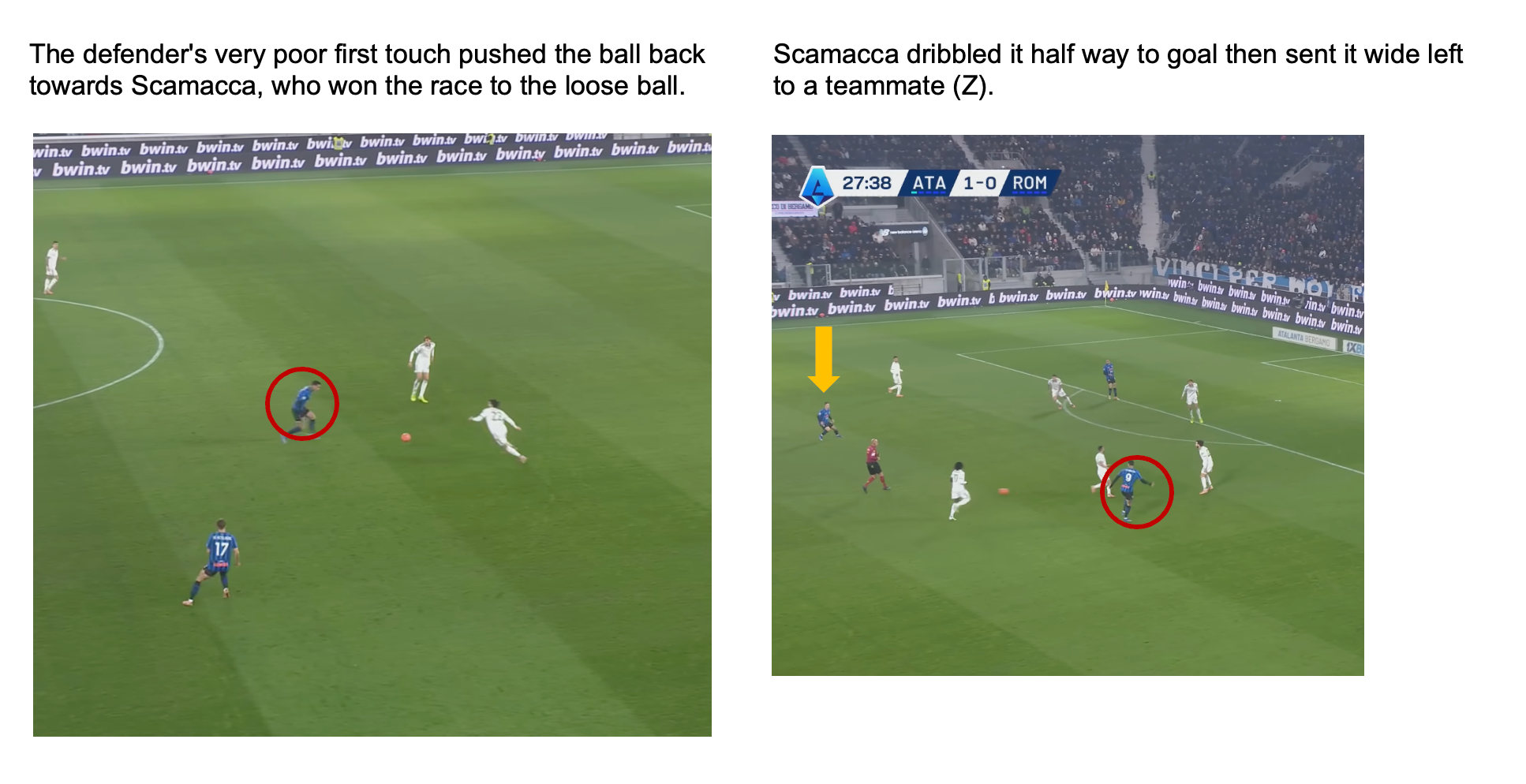
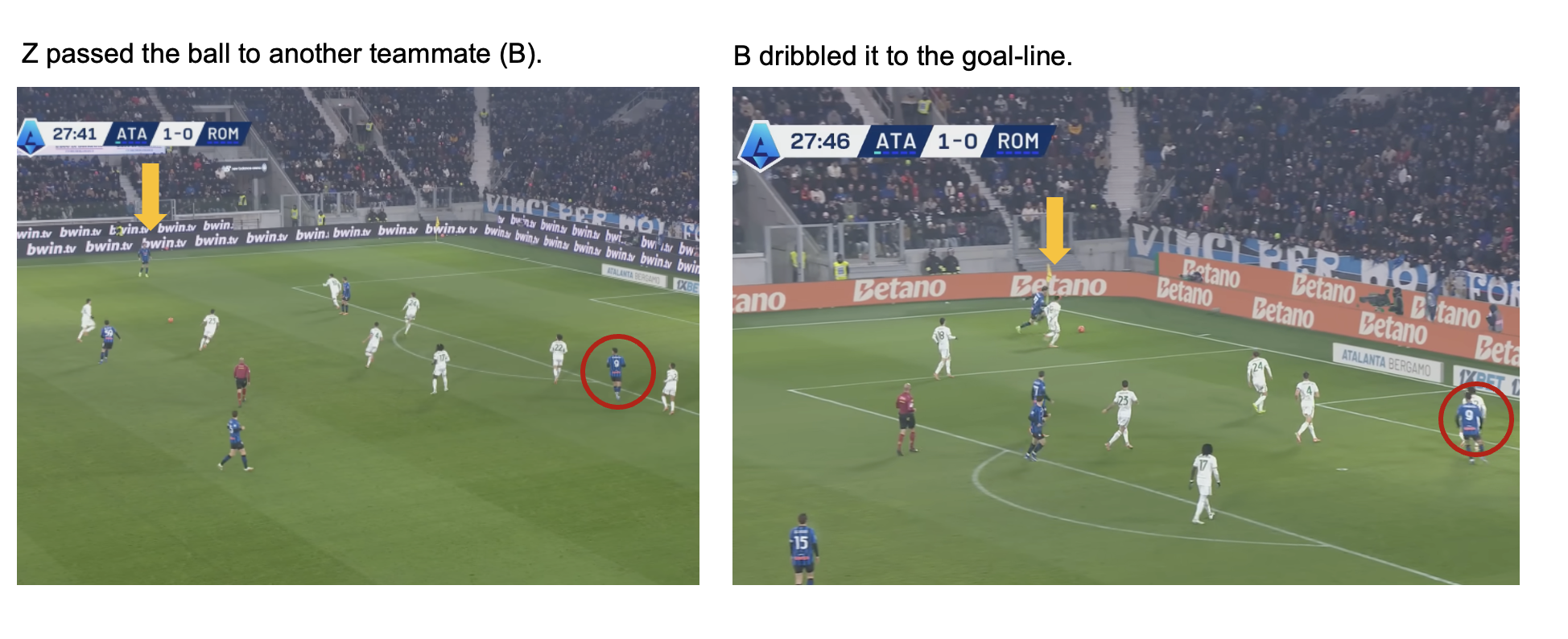
Scamacca then dribbled the ball half way to goal, then sent it to a teammate left. It then went to another teammate, who dribbled it to the goal-line and sent in an excellent cross.
By this time, Scamacca had positioned himself right in front of goal, and headed the cross in. The referee immediately signaled goal. Celebration ensued. The (home) stadium erupted.
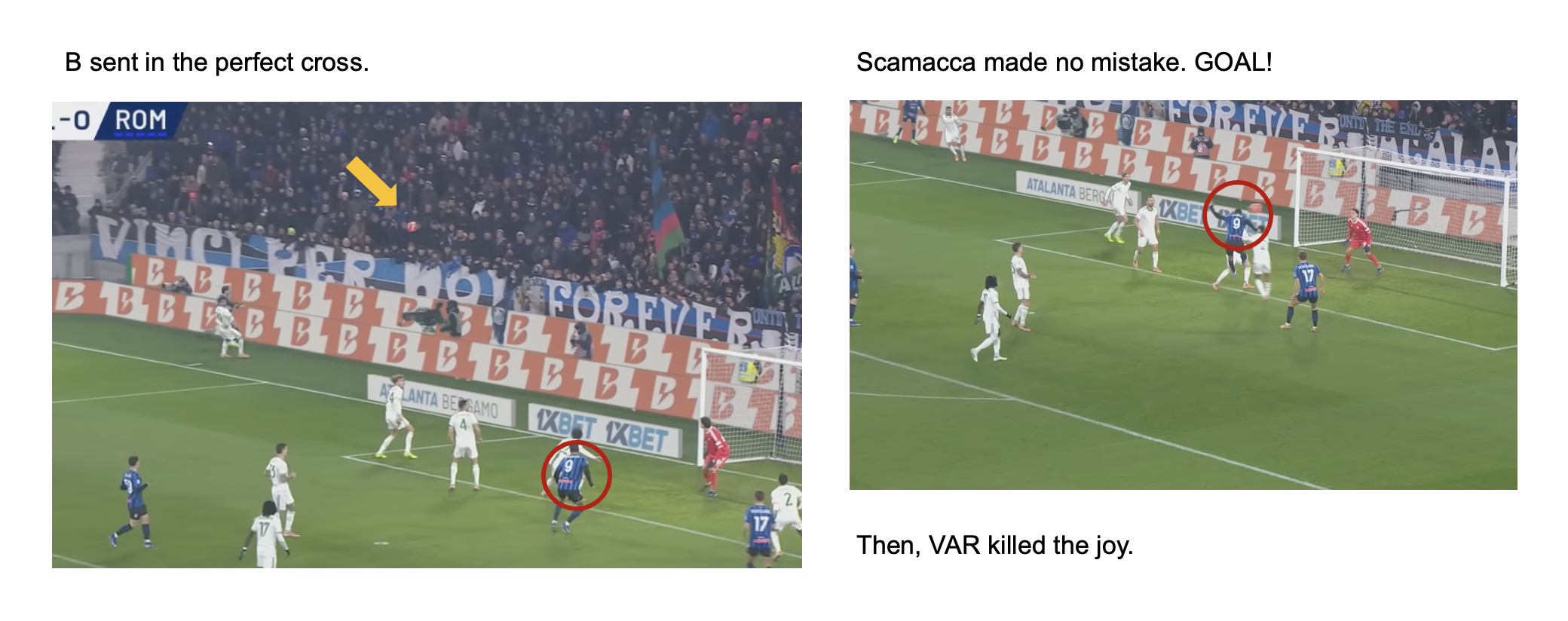
Even after the match was over, the officials' official stuck by the VAR ruling (link). With the greatest benefit of doubt, this decision can only be justified if we go by some ludicrously strict interpretation of the rules of the game. If they go down this path on every goal, the players might as well wait till the VAR officials had their say before starting their goal celebrations. Spectators can expect five to ten minutes' delay to confirm every goal. (This also has the side effect of adding loads of "injury time" to the end of each half, another negative.)
This process is inherently unfair because not even the officials' official would advocate combing through the rulebook word by word to adjudicate every goal. At best, they might do this when there is obvious controversy. This is precisely why I was so annoyed with that Atalanta-Roma decision. They are not targeting controversial goals. Almost everyone who watched that match would have accepted it as a clear goal, before the VAR process drowned us in minutiae.
In my understanding, the spirit of the off-side rule is to prevent the striker from gaining undue advantage by camping out behind the defense. Nothing of this sort was happening there.
Further, the above goal was an exceptional team and individual effort, a fantastically conceived and executed sequence. Now, all that is in the dustbin of history, soon to be completely forgotten. I really fail to see how this use of VAR technology improved the experience.
(I previously wrote about how VAR technology leads to "off-side" calls by a finger nail, which sends another bunch of beautiful goals to the dustbin, for the bragging title of I-go-strictly-by-the-book.)
A second recent example. In the Lazio-Fiorentina match on Jan 7, 2026, Fiorentina was rewarded a penalty kick in the dying minutes after a VAR review that overturned the on-field referee's original decision (of no penalty).
The video technology compiled a sequence of views to justify its decision. It showed that Gudmundson, the Fiorentina striker (in purple), fell to ground inside the penalty box with the Lazio defender (in light blue) hot on his back. There was no doubt that there was a tangle of legs. The Lazio player fell first but it appeared that his leg might have obstructed Gudmundson, causing him to lose balance.
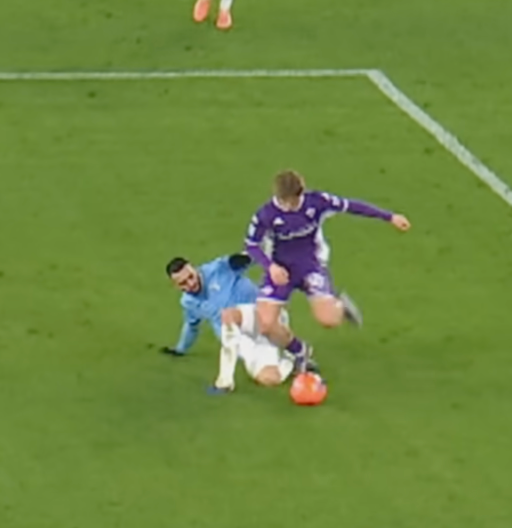
The intern (oops, I mean, the referee) was summoned to watch the video replay. The referee had signaled no penalty, which meant he had determined that Gudmundson deliberately put his leg out to touch the Lazio player, simulating a fall. As expected, he decided to change his call and rewarded Fiorentina a penalty.
Whether it was a foul or simulation is a question of the level of force, not a question of the relative positions of the legs. During the broadcast, viewers were shown a video replay. We kept seeing the legs tangling up. We agreed that they touched but who pushed whom? In my view, no amount of video can answer the question.
Video replays present deceptively objective views of reality. They aren't what they appear to be. The videos are compiled by the VAR technology to explain its decision. They cherry-pick the angles and vantage points to build evidence. We'll never see a video replay contradict the VAR decision. (Similarly in tennis, no replay will ever show a ball falling inside the line, if the line-calling bot has said it's out!)
This subject is near and dear to me because it's a real-world example of what happens when we use automated models to make real-life decisions.
Machines are only valuable if their conclusions differ from humans. If the machine always agree with humans, we don't need it. When the machines disagree with humans, we have two disagreeing points of view. How should a final decision be made?
Machines don't have special access to reality not visible to humans. Machines embody "models" of reality. These models express assumptions when there are not enough data. Embodied models are rarely explained, so these assumptions are not exposed, and thus not reviewable. In the case of VAR, particularly in the video replay cartoons, audiences have never been informed even one of the many assumptions that must have been adopted by the modelers.
Because they use models, machines can also make mistakes. They also have built-in biases, just possibly different biases than those found in humans. There will be certain aspects that human senses may work better, e.g. in judging the amount of force applied.
Machines have advantages, such as not subject to the variability between human referees. Think about that for a moment. We have made a trade-off: we agree to standardize on a single point of view (held by the developers of the technology); it's not that the problem of different opinions has vanished, we make it go away by adopting one viewpoint. It's like employing the same human referee for all matches.