What can one believe?
Example of AI slop

Andrew pointed us to someone else's investigation of an ultra-productive Chicago Business School professor named Nicholas Polson. According to this SSRN profile, he has published over two hundred papers, including 6 yesterday and 2 today (by 11 am).
This story has many points of interest.
First, this is the kind of doomsday scenario that AI skeptics love to evoke. It is very real. In the age of AI, I don't know how anyone can trust any online review. It's already getting hard to tell if a photo or video is depicting real life. Someone has certainly put up any number of AI-written novels, etc.
Second, let's practice some statistical sleuthing. The first red flag is 262 papers and 0 citations.
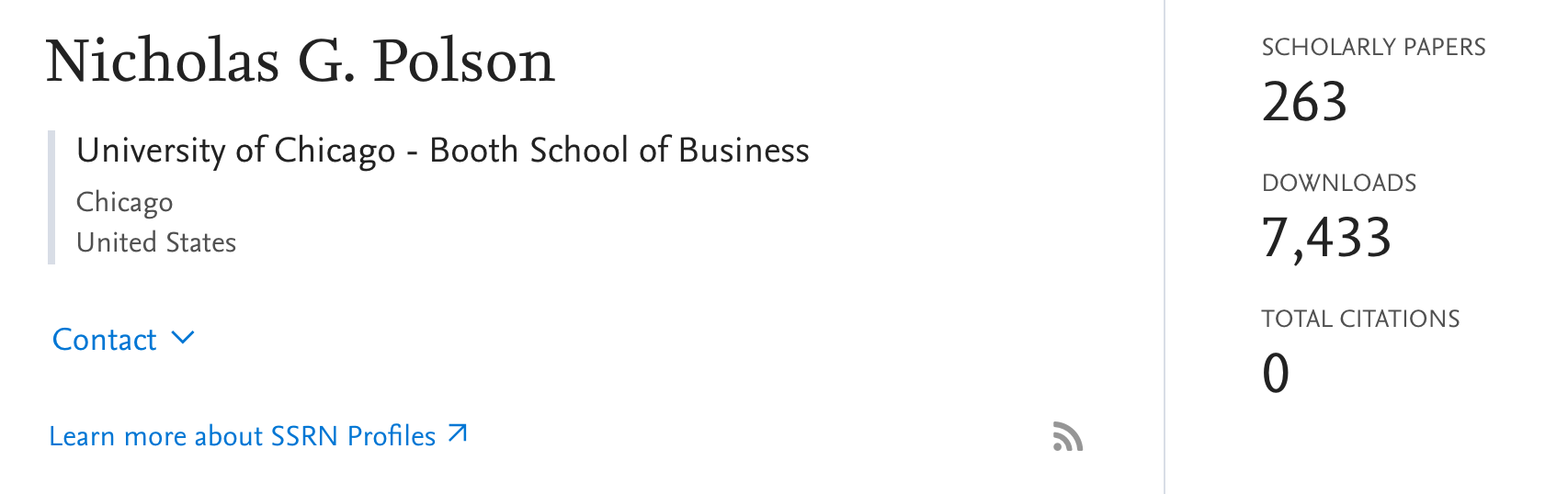
The second red flag is 0 citations but seven thousand downloads. This is what the social media people call a bad "ratio". In the world of Youtubes and Tiktoks, a low "like to view ratio" implies low-quality engagement (or even fake views). They have a 0 citation to download ratio here.
Now what? Is this his real profile?
I went to Prof. Polson's home page at the University of Chicago and clicked on his Working Papers link. This leads to the following SSRN profile:
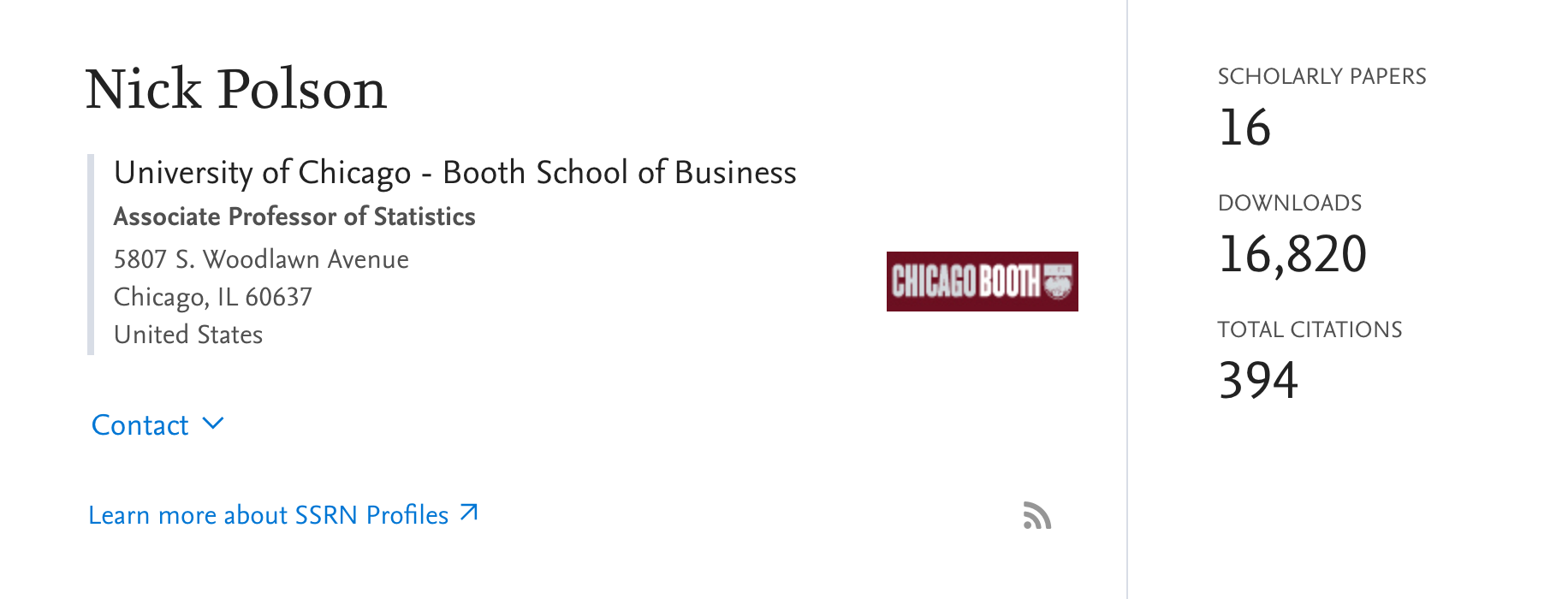
So it seems like he has two profiles, one possibly fake. He has a total of 16 papers published, and the most recent one was from 2018 (revised 2023).
Even though I have strong evidence that the profile cited by Andrew's correspondent is not the real one, we still don't know how the fake one was produced. Did the professor put it up there himself as some kind of experiment? Was it someone else's experiment? Why?
This is the limitation of a pure data analysis. We can find smoking guns but we can't tell the complete story.
P.S. [8-27-26] Andrew reports that the "fake" profile page is now off line. However, before it went poof, poor Nick's paper and download count went on a gradient descent!